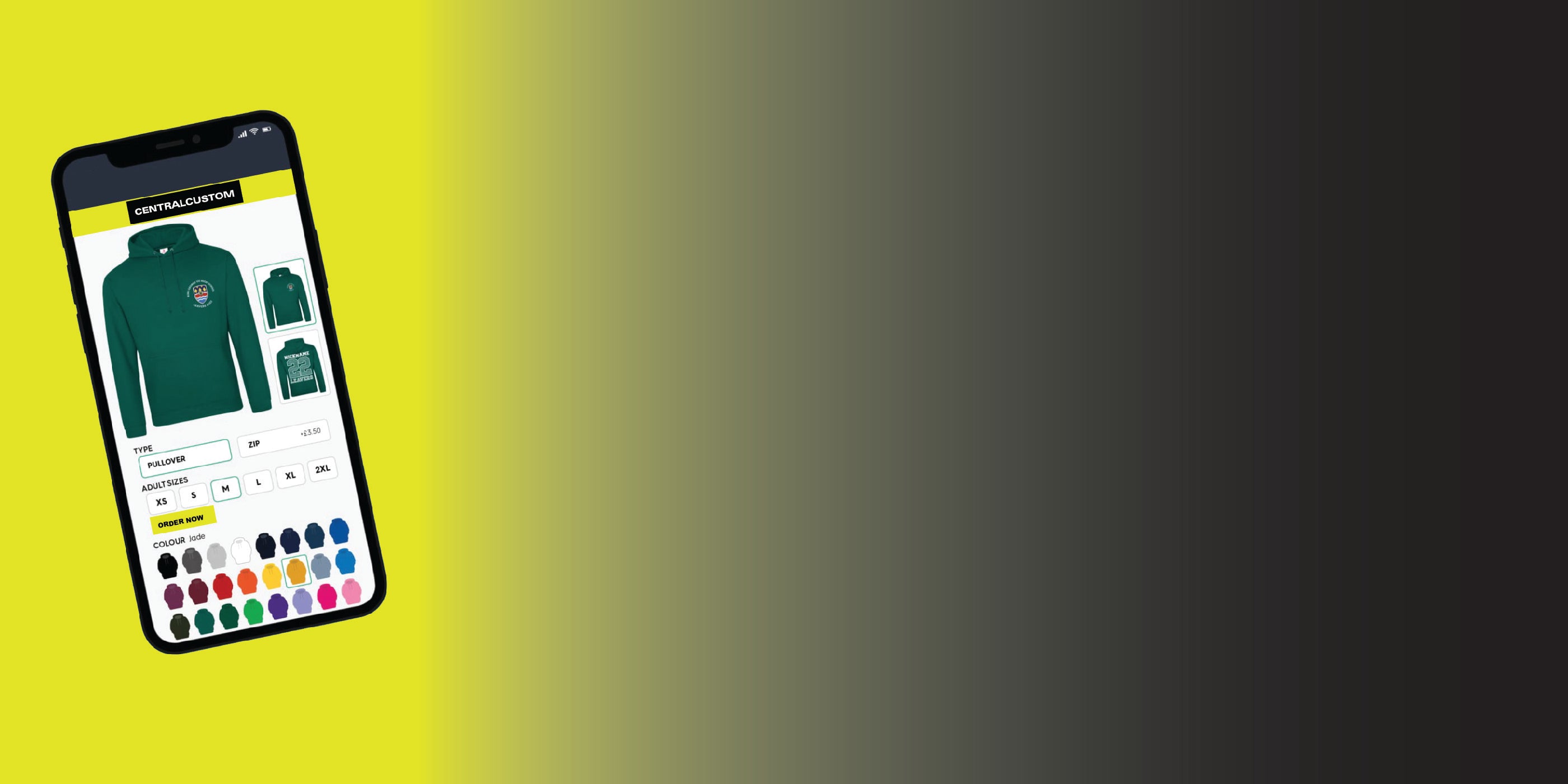
Almost every leavers hoodie order runs into the same bottleneck, and it is never the printing. It is the list of names for the back.
On paper it is the simplest part of the job: type out everyone in the year group, send it over, done. In practice it is where the arguments happen. Someone gets left off. Someone’s nickname is vetoed. Two pupils share a first name and only one of them ends up with a surname initial. Someone joins in May, after the list closed. And because the back print is the part everyone actually looks at, a mistake there is the one people remember.
This guide covers how to build a name list that reads well, fits on the garment, and does not cause a row in the last half-term of the year.
What a back print name list actually is
The classic leavers hoodie back print is the full year group’s names arranged as a single block of text. That block is usually set in one of three ways:
- A rectangle or “wall” of names — the most common, the most readable, and the one that copes best with large year groups.
- A shape — names arranged inside a number (the leaving year), a school crest outline, a heart, or a county silhouette.
- A list with a feature name — everyone’s name at a small size, with the wearer’s own name printed larger across the shoulders or at the centre.
The shape options tend to look better in a mock-up than they do on a garment when the year group is large, because filling a shape forces wildly varying text sizes. Above roughly 120 names, a straightforward block will almost always look sharper on the hoodie.
Decide the naming convention first
This is the single decision that saves the most time. Agree it once, at the start, and apply it to everyone.
First names only
Standard for primary schools and increasingly common in secondary. It is cleaner, it fits more names in, and it sidesteps the conversation about printing pupils’ full names on clothing they will wear in public. The obvious problem is duplicates.
First name plus surname initial
Solves duplicates while keeping the list tidy — “Ella P” and “Ella T”. If you use it for one pair you should use it for every duplicate, or the pupils with initials look singled out.
Full names
Most common at sixth form, college and university level, where the group is older and smaller. Check your school’s position before you assume it is fine.
Whichever you pick, write it down and tell the year group. Half the complaints about name lists come from inconsistency rather than from the convention itself.
The nickname question
Nicknames are the most enjoyable part of a leavers hoodie and the most likely to get the whole design sent back.
Some schools ban them outright. Others allow them but reserve a veto. The practical approach is to assume every nickname will be read aloud by a senior member of staff, because it will be. Anything that could be read as a dig at appearance, background, ability or a member of staff will not survive sign-off, and one bad entry can send the entire design back for another round.
If you want nicknames, collect them in a separate column next to the real name. That way, if the school strikes some out, you swap in the real name without rebuilding the document. Our guide to getting your leavers hoodie design approved by school goes into more detail on what tends to get rejected.
Collect the list in one place, once
The name list should live in one document that one person owns. Not a group chat, not a stack of paper slips, not four separate spreadsheets from four form tutors.
A single shared spreadsheet with a row per pupil works best, with columns for:
- Name exactly as it should appear on the print
- Nickname, if you are using them
- Size ordered
- Paid — yes or no
Keeping names and sizes in the same document means you only chase people once. It also means that when someone drops out you delete one row, rather than trying to reconcile two lists that no longer match.
Ask people to check their own entry, in writing, before the list closes. Ten minutes of self-checking prevents almost every spelling complaint.
Spelling, accents and the things that get missed
We can typeset a name list beautifully. What we cannot do is know that “Siobhan” should be “Siobhán”, or how a particular pupil spells their name. Whatever you send is what gets printed.
Three checks worth doing before you send:
- Accented and non-Latin characters. Flag them explicitly when you send the list so they are not lost in a copy-paste.
- Autocorrect damage. Spreadsheets are enthusiastic about “correcting” surnames. Check the list in the final document, not in the version you originally typed it into.
- Sort order. Decide whether the block is alphabetical, by form group, or deliberately random. Alphabetical is easiest to proofread for missing names; random looks more natural on the garment.
How many names actually fit
There is no fixed limit, but there is a practical one, and it is about legibility rather than space.
A standard adult back print area is roughly A3-sized. A year group of 60 sits comfortably at a size you can read from across a room. At 150 names the text gets noticeably smaller. Beyond around 250 names, individual names start to become hard to pick out at arm’s length and the block reads more as texture than as a list.
Two things help large year groups:
- Drop the shape. A plain justified block uses the available area far more efficiently than a number or crest outline.
- Use a condensed typeface. It fits more characters per line at the same height, which keeps names readable.
If your group is very large, ask for a proof at actual size and look at it printed on paper before approving. On a phone screen everything looks legible.
Set a cut-off date — and a real one behind it
Name lists never close on the first deadline. Plan for that.
Announce a cut-off, then hold your actual order date a week or two later. The published deadline brings in the bulk of the list; the private buffer absorbs the stragglers without putting the delivery date at risk.
Once a job goes into production the list is fixed. If your year group is likely to change — new arrivals in the summer term, or pupils you have not managed to reach — consider ordering a few extra hoodies with the design but no name list, so nobody ends up with nothing.
Sign-off: one version, one approver
Before the order goes in, produce a final version of the list, mark it clearly as final, and have one named person approve it. Not a committee. One person.
When your digital proof arrives, check the name block against that final document line by line. It is tedious, it takes twenty minutes, and it is the last opportunity to catch anything. Once the proof is approved, the print is made from it.
Frequently asked questions
Can we add a name after we have approved the proof?
Not once the job is in production. If a late addition is likely, tell us before you approve and we will advise on the best option — usually holding the order briefly, or ordering a small number of spares.
What if two pupils have the same first name?
Add a surname initial to both. If you are using first names only across the list, apply the initial consistently to every duplicate rather than singling out one pair.
Can the name list be embroidered instead of printed?
Realistically, no. A dense block of small names is a printing job — screen printing or DTF transfer will hold the detail, while embroidery will not at that size. Embroidery is a good choice for a small chest logo or crest on the same garment. Our embroidery or print guide explains where each method works.
Should staff names go on the hoodie?
That is a school decision. Where staff are included, they are usually set as a separate small line beneath the pupil block rather than mixed in with it.
How should we send the list to you?
As a single typed document — a spreadsheet or a plain text file is ideal. Please avoid photographs of handwritten lists; that is where transcription errors come from.
Ready to order?
Browse our leavers hoodie range, or if your year group is finishing in summer 2027, start with our Class of 2027 leavers hoodies page. Send your design idea and name list to promo@centralcustom.co.uk and we will come back with a proof and a quote.