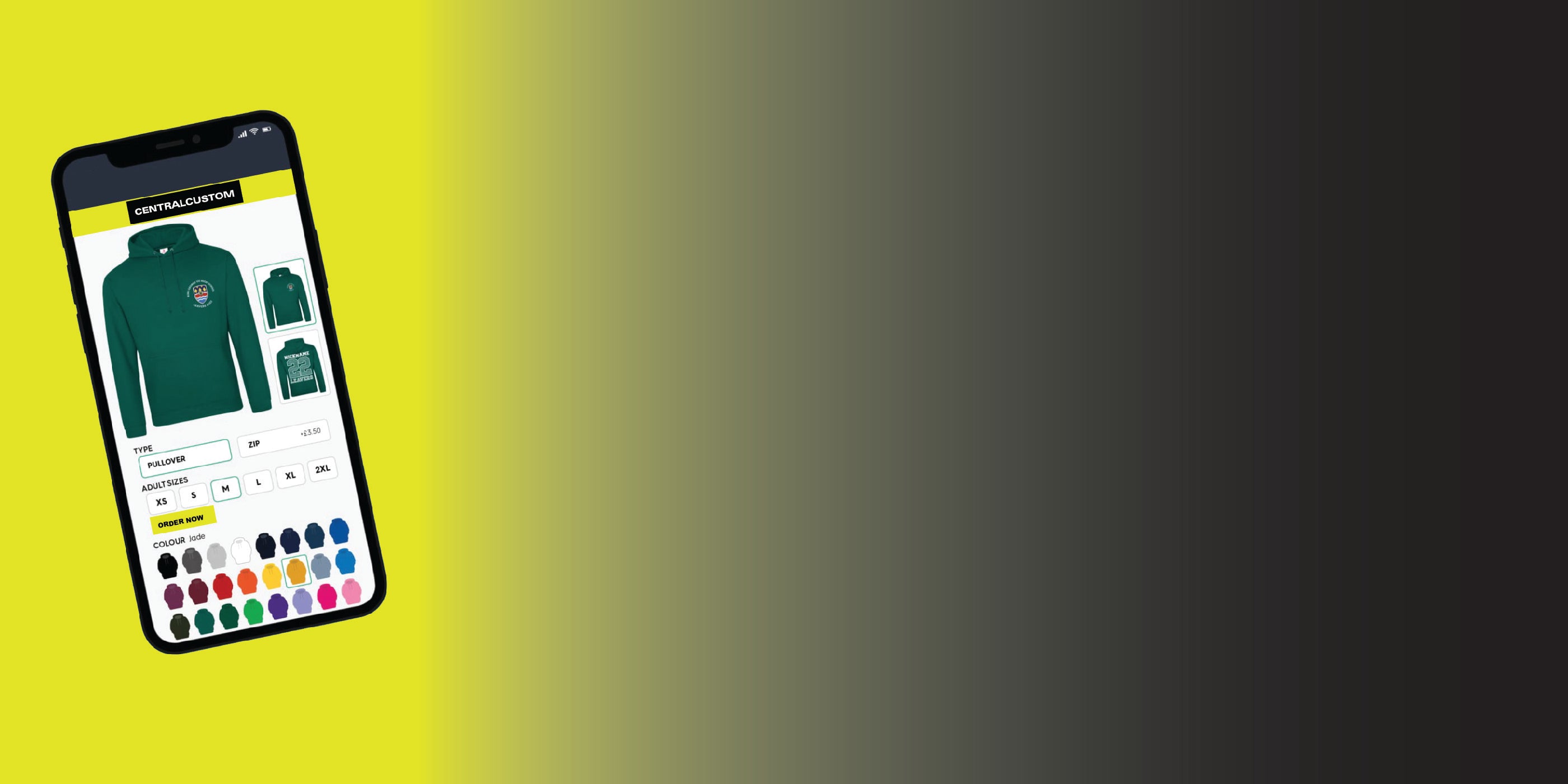
Colour is almost always the first thing a year group argues about, and the last thing anyone agrees on. It is also the decision that most affects whether the hoodie gets worn after results day or lives at the bottom of a wardrobe. Here is how UK schools, sixth forms and universities actually settle it.
Quick answer: Most UK year groups choose black, navy or heather grey for leavers hoodies, because they suit every skin tone, hide marks, and let a light-coloured name list on the back stand out clearly. Check your school’s policy first — many require a specific colour or ban anything close to current uniform. Decide the garment colour and the print colour together, not separately, because contrast between the two is what makes a back print readable.
Start with what your school will actually allow
Before any vote, find out the rules. Schools commonly restrict leavers hoodie colours for three reasons: the hoodie must not be mistakable for uniform, staff need to identify Year 11 or Year 13 at a glance, or the school wants it to sit alongside house colours. Some schools specify a single colour outright.
Ask your head of year in writing and get the answer before you show anyone a design. A colour vote that has to be re-run because the winning shade was never allowed is the single most common way leavers hoodie orders lose two weeks. Our guide to getting your leavers hoodie design approved by school covers what to put in that request.
The colours most UK year groups end up choosing
Across primary, secondary and university orders, the same handful come up again and again — for good reasons.
- Black — the safest choice and the most-ordered. It flatters everyone, hides ink and grass stains, and makes white or metallic-effect print pop. The downside is that it is hot in a June heatwave and it is what every other year group picked.
- Navy — nearly as versatile as black but softer, and it photographs better in group shots. Watch out if your uniform is already navy; many schools rule it out for that reason.
- Heather or sport grey — the most popular alternative to black. It looks less like uniform, works with almost any print colour, and is noticeably cooler to wear in summer term. Marks show more easily.
- Bottle or forest green — a strong choice for year groups who want something distinctive without going bright. Reads well with white or gold print.
- Burgundy — smart, a little more grown-up, and popular with sixth forms and universities. Avoid if it clashes with your school crest.
Bright colours — red, royal blue, sky blue, pink — work when the year group genuinely wants a statement piece, and they photograph brilliantly. They are just worn less often afterwards, and they narrow your print options because dark print on a bright garment can look muddy.
Choose the garment colour and the print colour together
This is where most designs go wrong. A back print listing 120 names only works if there is real contrast between the ink and the fabric. As a rule:
- Dark garment, light print. White, cream or pale grey on black or navy is the most legible combination there is, and the safest for a long name list.
- Light garment, dark print. Black or navy on heather grey or white works well, though very fine text on a marled grey can lose definition.
- Avoid mid-tone on mid-tone. Royal blue print on a bottle green hoodie will look fine on screen and disappear at three metres.
The more names you are fitting on, the smaller each name has to be, and the more contrast matters. If you are planning a full year-group list, read our guide to name lists and back prints before you lock the colour in.
Embroidery behaves differently again. Thread has its own sheen, so a colour that looks flat in print can look rich stitched — but embroidery is not suited to long name lists, so most year groups embroider the front crest and print the back.
How the fabric changes the colour
The same colour name does not give the same result on every garment. A polycotton hoodie takes dye differently from a heavier cotton-rich one, and heather shades are marled by design, so print sits over a mottled background rather than a flat one. Weight matters too: a heavier hoodie holds a deeper, more saturated colour. Our guide to leavers hoodie fabrics, cotton, polycotton and GSM explains what to expect from each.
If colour really matters to your group, ask for samples. We send them on request, and seeing two shades side by side in daylight settles arguments that three weeks of group chat will not.
How to run the colour vote without a three-week argument
Open votes with unlimited options do not converge. What works:
- Shortlist first. Take the school-approved colours and cut them to three or four. A committee of four can do this in ten minutes.
- Show the actual design, not swatches. Put your real front logo and back print on each shortlisted colour so people vote on the finished thing.
- One round, fixed deadline, majority wins. Announce the closing time before you open it.
- Let staff have a say if staff names are going on. It avoids an awkward conversation later.
Give the whole process a week. Anything longer and the momentum goes, which matters because collecting names and sizes still has to happen afterwards.
The colours that date fastest
Leavers hoodies get looked at again years later. Very on-trend shades — whatever this year’s viral colour happens to be — tend to date hardest, as do neons. Anything that closely matches the school uniform tends to get worn least, because it reads as school clothing rather than a keepsake. If your group is split between a bold colour and a classic one, the classic one gets worn more in the years afterwards. The bold one gets more photos on the day.
Frequently asked questions
Can different pupils have different colours?
Yes, though most year groups do not. Mixed colours look striking in photos but weaken the sense of a single group, and they make distribution slower. A common middle ground is one hoodie colour for pupils and a different one for staff.
Does colour change the price?
Garment colour itself usually does not. What moves the price is the number of print colours, whether you print one side or both, and quantity. We have no minimum order, so smaller groups can still order — the unit price simply improves as numbers rise.
Can we see the colour before we commit?
Yes. Ask for samples, and you also get a free digital proof showing your design on your chosen colour before anything is produced. Nothing goes to print until you approve it.
How late can we change our minds?
Up until you approve the proof. After that the order goes into production, and hoodies are typically dispatched 7–14 working days later.
The bottom line
Check the school rules, shortlist to three or four, decide garment and print colour as one decision, and give the vote a hard deadline. Black, navy and heather grey remain the most-worn choices for a reason — but the right colour is the one your year group picked themselves and will still put on in two years.
Ready to start? Browse our leavers hoodies and hoodie range, see the options for primary school leavers hoodies, or request a leavers pack with samples and pricing — we quote within one working day.